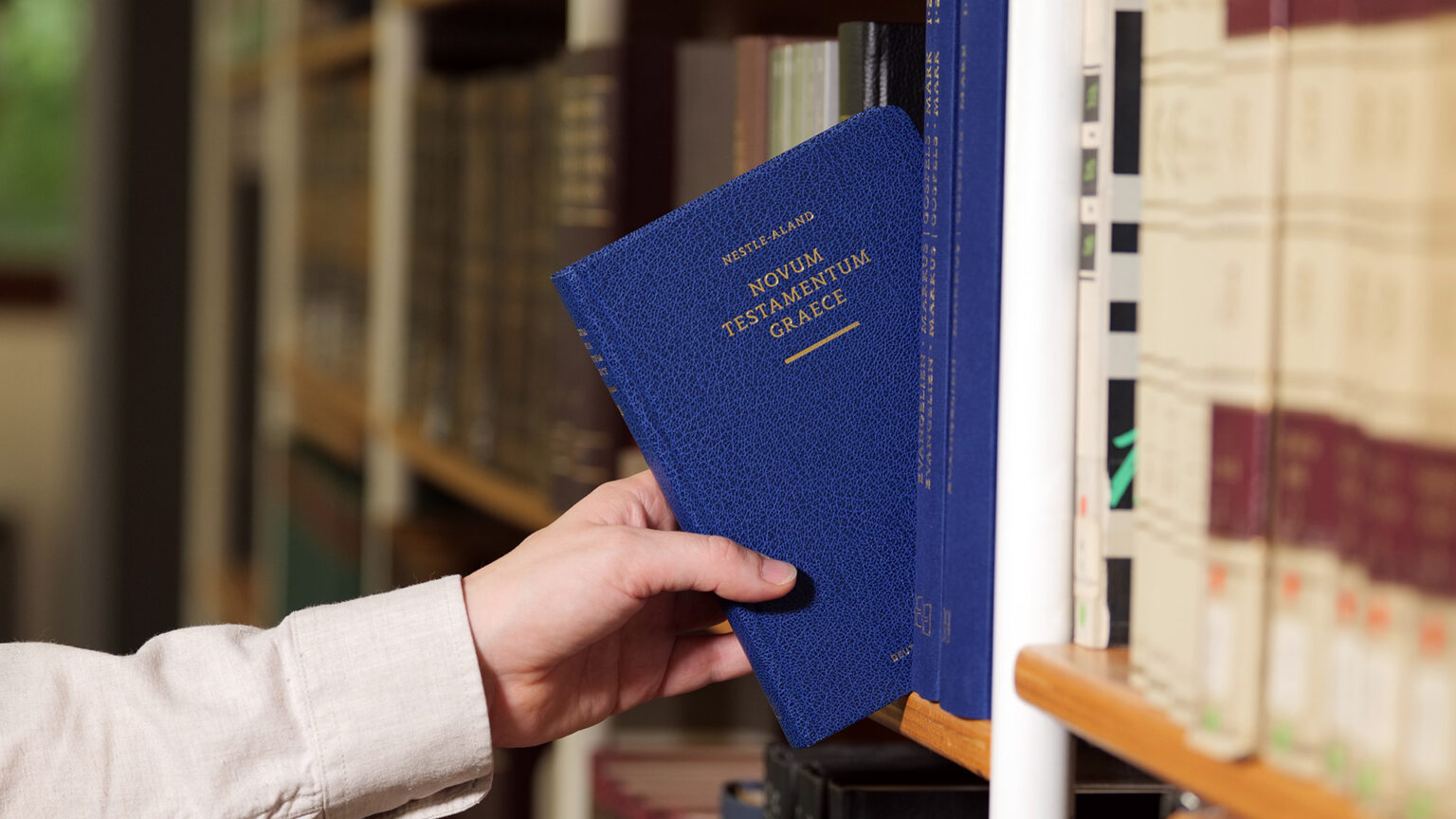
The „Nestle’s“ History


The „Nestle’s“ History
The Beginnings (First Edition, 1898)

The Novum Testamentum Graece was first published in 1898 by the Württemberg Bible Society (Germany). It was edited by Eberhard Nestle and followed a simple but ingenious principle: Nestle compared the three most significant editions of the Greek New Testament from the 19th century (Tischendorf, Westcott/Hort, and Weymouth; the last mentioned was replaced by the edition of B. Weiss in 1901).
Wherever one of these versions differed from the other two, Nestle adopted the reading given in the two identical versions and supplied a note in the apparatus showing the divergent reading. By this means, he grouped together the best findings of New Testament textual research from the 19th century and prevented one-sided views from becoming established. Due to its wide distribution, Nestle’s edition ultimately displaced the “Textus Receptus” in churches and schools, which had already become obsolete among scholars.
Until the 13th Edition (1927)
The text of the first edition was reprinted several times in subsequent years. Under Erwin Nestle, Eberhard’s son, this edition was further developed: for the first time, an independent apparatus criticus was added that cited not only other scholarly editions (see above), but also the most important reference manuscripts, giving their precise readings. However, Nestle did not consult the manuscripts directly, but continued to compile the information on their readings from other scholarly Editions.
The 25th Edition (1963)

Kurt Aland (co-editor since 1952) was the first to verify the information in the text and critical apparatus against the documents themselves. Together with his colleagues at the Institute for New Testament Textual Research (INTF), which he established in 1959, he also extended the apparatus to include readings from many additional manuscripts.
This new approach reached its early culmination in 1963 with the 25th Edition (thereafter known as Nestle-Aland), which was frequently reprinted. From 1955 Aland was also a member of the editorial committee of the Greek New Testament (UBS).
The 26th Edition (1979) as a turning Point
The great manuscript discoveries of the 20th century (especially of early papyri) necessitated a fundamental reorientation of the principal text and a rewriting of the apparatus, and these were both introduced in the 26th Edition. Ongoing work on both the Novum Testamentum Graece and the Greek New Testament was now being overseen by the same editorial committee (formed in 1955), and the principal text of the former edition was now identical to that of the latter one. Since then, the two most widely used scholarly editions of the Greek New Testament have shared the same biblical text and differ merely in terms of their apparatuses, introductions, and appendices.


27th Edition (1993)
In this revision, the text-critical apparatus was once again extensively revised to improve reliability and reader-friendliness.
28th Edition (2012)
This edition had to accomplish two different tasks. First, the apparatus had to be revised thoroughly to give it more clarity and make it easier to use. Secondly, the text-critical insights and decisions resulting from work on the Editio Critica Maior of the Greek New Testament had to be incorporated. This resulted in changes especially in the Catholic Letters, including changes to the biblical text.