
The Greek New Testament: History
The Greek New Testament: History
The First Edition (1966)
On the initiative of the American Bible Society—especially of Executive Secretary for Translations, Eugene Nida—a committee of experts was formed in 1955 to prepare a new edition of the Greek New Testament. Its members were Kurt Aland, Matthew Black, Bruce Metzger, and Allen Wikgren. Later on, the Bible Societies of Scottland, Württemberg, Netherlands and Great Britain joined the project.
The new edition was especially oriented towards the needs of biblical translators. Accordingly, the first edition of The Greek New Testament (1966) offered only variant readings for passages in the apparatus that were particularly uncertain or of great significance for the purposes of translation and exegesis. It also provided translators with a clear and convenient method for assessing each variant in the Greek text, using the letters A–D to indicate the editors’ level of confidence about its authenticity.
Furthermore, a punctuation apparatus was added to the text-critical apparatus that laid out differences in punctuation relevant to the meaning of the text in various Greek editions and in significant modern translations.
In the first edition, the Greek text included a number of deviations from the text printed in the Nestle-Aland up to its 25th Edition.
The Third Edition (1975)
The committee's intensive work brought about a fundamental revision of The Greek New Testament. Since the third edition, published in 1975, the Greek text has been identical to that of the Nestle-Aland Novum Testamentum Graece, whose parallel edition, the 26th, was published in 1979. For the third edition, the punctuation apparatus and the index of Old Testament references and quotations were also thoroughly revised by the Translation Department of the American Bible Society.
The Third Corrected Edition (1983)
While the Greek text remained largely unchanged and was modified only in matters of punctuation, the Institute for New Testament Textual Research (INTF) which was meanwhile editing The Greek New Testament together with the Nestle-Aland Novum Testamentum Graece updated the text-critical apparatus, building on the work done for the 26th edition of Nestle-Aland, published in 1979.
The Fourth Revised Edition (1993)
Parallel to revisions made to the 27th edition of the Nestle-Aland, the text-critical apparatus of the Greek New Testament was modified again (while the Greek text remained unchanged). At the same time, the punctuation apparatus was also re-edited by the United Bible Societies (UBS).
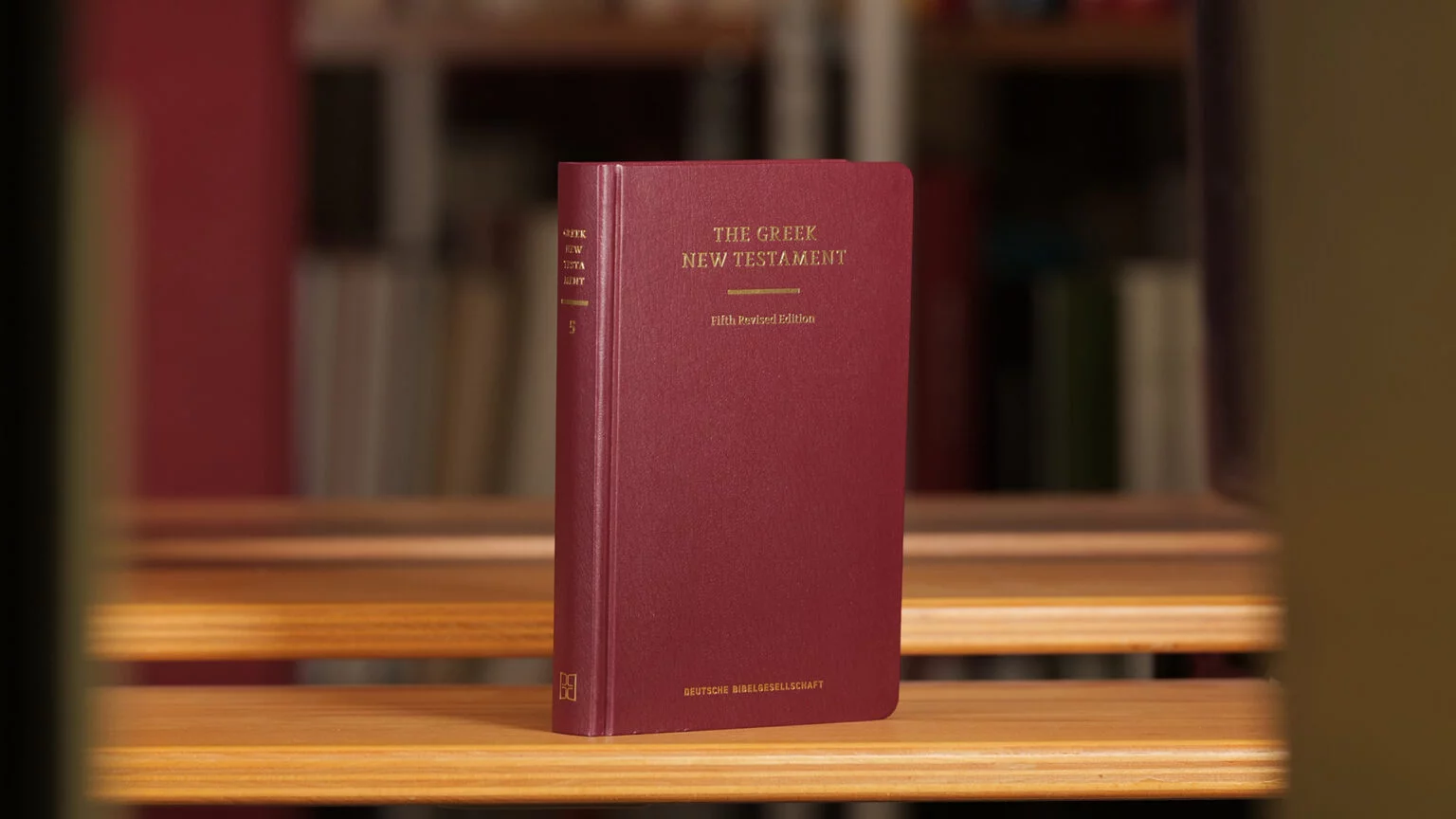
The Fifth Revised Edition (2014)
In its fifth edition, significant corrections and additions were incorporated into The Greek New Testament. For instance, the readings of the newly discovered papyri 117–127 have been included in the critical apparatus.
A fundamentally new approach was adopted for the Catholic Letters, following the completion of the Editio Critica Maior (ECM) for these writings. The ECM represents a new benchmark in textual scholarship and provides a newly established text based on the most comprehensive research to date. These findings and results were accordingly integrated into The Greek New Testament.
Similar revisions were also adopted in the 28th edition of the Nestle-Aland Novum Testamentum Graece, with which The Greek New Testament continues to share an identical Greek text.