Deutsche Bibelgesellschaft

Mission and History of the German Bible Society

Our Mission Statement

The Deutsche Bibelgesellschaft (German Bible Society) is a not-for-profit religious foundation. It is engaged in translation of the Scriptures, the development and dissemination of innovative Bible editions, and in giving all people access to the message of the Bible. It bears international responsibility for scholarly Bible editions in the original languages. Through its international programs, in collaboration with other members of the United Bible Societies, it supports translation and distribution of the Bible worldwide, so that everyone can read the Bible in their own language.

Our History: Over 200 years of Biblical Expertise

On 11 September 1812, pastors, senior officials and merchants founded the Württemberg Bible Society at the home of merchant Tobias Heinrich Lotter on Stuttgart's market square. The initiative came from the British and Foreign Bible Society. Karl Friedrich Adolf Steinkopf, a native of Württemberg and pastor of the German expatriate community in London, travelled across mainland Europe in 1812 on behalf of the British Bible Society and found support for his cause first in Stuttgart.

At its very first meeting, the Bible Society formulated its purpose as ‘the dissemination of the Bible among the poorer classes in Protestant Württemberg’. The Bible was to be produced and distributed in Martin Luther's translation. King Friedrich I. of Württemberg placed the society under the authority of the Royal Board of Education and at the same time granted it the privilege of free postage. In 1862, the statutes were amended, as originally Bibles were allowed to be distributed only in the home country. After that, the Bible Society increasingly supplied German-speaking emigrants with Bibles. At the beginning of the 20th century, the Württemberg Bible Society distributed more Bibles in Germany than any other Bible society.

The call for a unified German Bible Society became particularly loud in 1871 with the founding of the German Empire. However, this remained unheard for a long time. It was not until 1948 that the Association of Protestant Bible Societies in Germany was founded, which then joined the United Bible Societies. In 1976, the Bible societies which were active in printing, the Cansteinsche and the Württemberg Bible Society and the Evangelisches Bibelwerk, transferred their publishing activities to a newly founded Deutsche Bibelstiftung (German Bible Foundation).

On 1 January 1981, the Deutsche Bibelstiftung and the Evangelisches Bibelwerk merged to form the Deutsche Bibelgesellschaft/Evangelisches Bibelwerk in the Federal Republic of Germany and West Berlin (German Bible Society). Today, 26 regional Bible societies belong to the General Assembly of the German Bible Society. Bible centres, educational programmes and other initiatives serve to open the Book of Books to people today.

The Weltbibelhilfe (‘World Bible Aid’) of the German Bible Society is committed to the worldwide translation and distribution of the Bible. Since its foundation in 1975, more than 100 million euros have been made available for this purpose with the help of donors. There is still a need, as many Christians in poorer countries are still waiting for their own Bible in their native language.

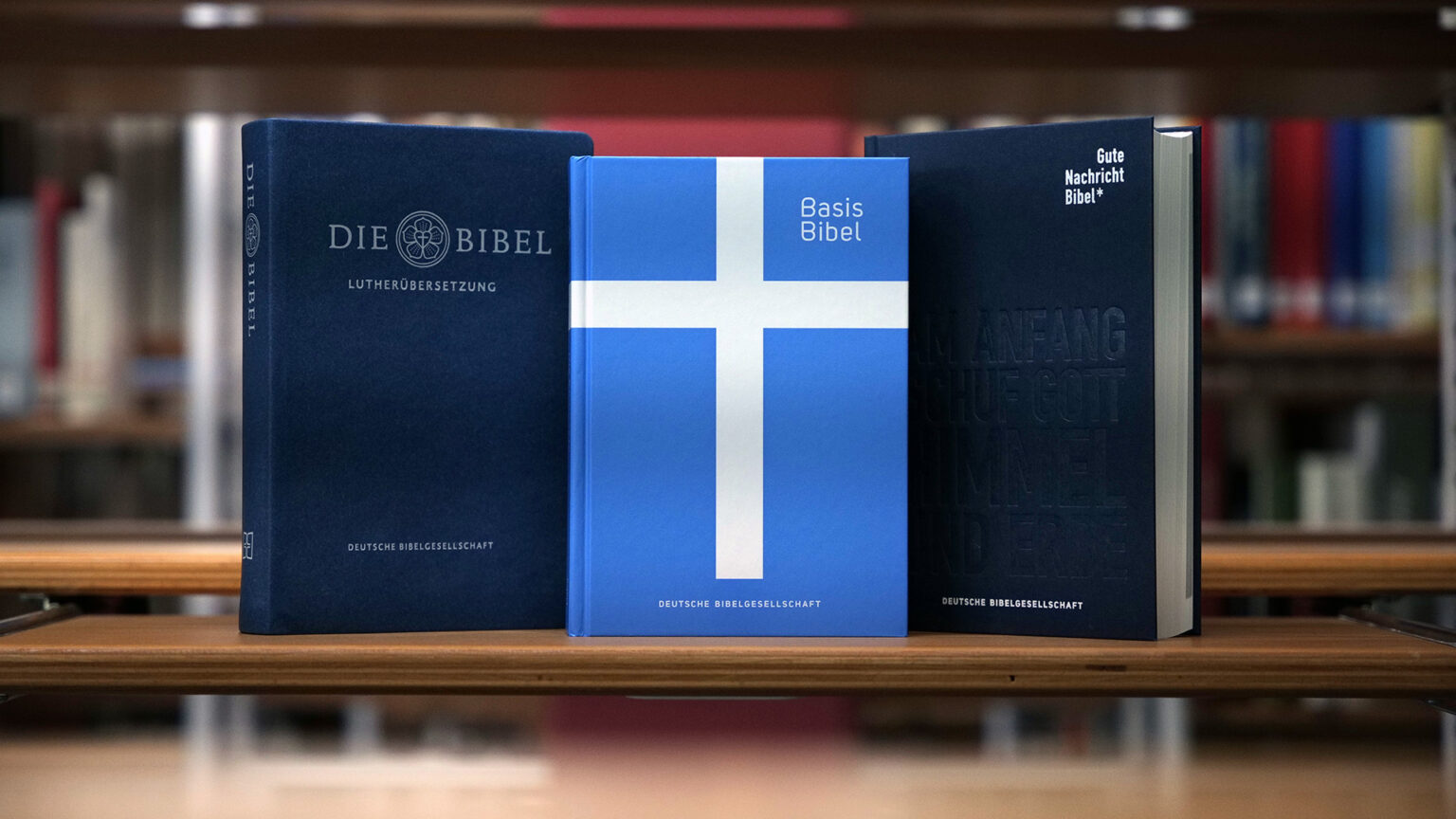
From the very beginning, the Luther Bible has been at the heart of the Bible Society's work in Germany. This also includes its history of revisions: It began with the creation of the first uniform official church text in 1892 and led, through various revisions, to the 1984 version, which was adapted to the new German spelling with minor changes in 1999. From 30 October 2016, the revised Luther Bible 2017 is the official Bible text recommended by the Evangelical Church in Germany (EKD).

The Bible Society has also published new translations for people who are no longer familiar with the classic church language. The first of these was the Gute Nachricht Bibel (‘Good News Bible’). To this day, it remains the only consistently interdenominational Bible translation. Today, the Bible Society also publishes the cross-media BasisBibel, which is aimed at a new generation of media users. Children's Bibles are also part of the publishing programme.

The German Bible Society also continues the tradition of publishing scholarly editions. In 1898, the Novum Testamentum Graece, compiled by Eberhard Nestle, was published for the first time in Stuttgart. The ‘Nestle-Aland’, named after its editors, and the UBS Greek New Testament, also published by the German Bible Society, serve as authoritative basis for scholarly work on the New Testament and for translation worldwide. It is edited by the Institute for New Testament Textual Research in Münster with which the Bible Society closely co-operates. A completely new edition of the Greek New Testament, the Editio Critica Maior, is currently being produced there, documenting the complete textual history of the New Testament. The Biblia Hebraica, developed by Rudolf Kittel, was published as a scholarly edition of the Old Testament by the Bible Institute in the 1920s. Since 1977, the Biblia Hebraica Stuttgartensia has been available as the world's only critical edition of the entire Hebrew Old Testament. A new edition, the Biblia Hebraica Quinta (BHQ), is currently being prepared with international and interdenominational editorship.

German Bible Society

Balinger Straße 31 A
70567 Stuttgart
info@die-bibel.de

Deutsche Bibelgesellschaftv.4.42.5